How Many People Telecommute?
Estimates of how many people telecommute and how often they do it vary widely.
Based on the latest American Community Survey data, slightly more than 2% of the U.S. employee workforce (2.8 million people, not including the self employed or unpaid volunteers) considers home their primary place of work. (Kate Lister, Telework Research Network)
Based on all the research we’ve done, our estimate is that 20 to 30 million people currently work from home at least one day a week. 15 to 20 million are road warriors / mobile workers; 10 to 15 million are home businesses; 15 to 20 million work at home part time (with about half doing so 1-2 days a week; and about 3 million are based at home full time. (Kate Lister, Telework Research Network). WorldatWork estimates that about 44 million people work at home at least once a year.
Additional details from a wide range of studies are available on our Telecommuting Statistics and Pros & Cons of Telecommuting pages.
The counting problem isn’t because no one has bothered to study the work-at-home population. The IRS, Bureau of Census, Bureau of Labor Statistics, Small Business Administration, and a number of private researchers all collect data about people who work from home. But they all come at it with their own needs and biases.
Some researchers count small businesses, others don’t. Some include people who work from home as little as one day a year, while others focus on people who primarily work from home (Census). Some fail to distinguish between paid and unpaid work (BLS and Census). Most extrapolate on statistical samples rather than full counts. None separate out those employees and business owners who work at home from those who work from home.
I interviewed Bruce Phillips, a researcher for the National Federation of Independent Business (NFIB) when I was researching my book last year. He described the task of trying to find the real work-at-home numbers as a “statistical Vietnam—the data goes in, but you can’t get it out.”
As a result, studying the work-at-home population is a little like trying to study meteoroids. We know there are a lot of them and we know they’re important, but we don’t know where they all are and not everyone agrees on which ones to count.
Personally, for U.S. numbers, I lean toward Census data. They ask employed workers where their principal place of work was during the survey week. Granted, some may have had an unusual week, but the numbers for 2008 show that 5.9 million called home their principal place of work. Of those, 3.1 million were home based businesses (both incorporated and unincorporated-numbers that are rarely broken out). That means that only 2.8 million employees, just over 2% of the non-self-employeed employee population, work at home most of the time. That’s a long way from the 52 million people who hold telecommuting-compatible jobs.
Of course I have my biases too. I’m interested in the people who regularly work from home because they are the ones who have the greatest impact on global warming, fuel supplies, and traffic congestion. They’re also the ones who derive the most work-life benefits from the arrangement.
While companies such as IBM and Cisco call a high percentage of their staff teleworkers, few of them actually work both from home and at home. These road warriors, plumbers, electricians, etc. should be labeled differently than the from home/at home population if we’re to really understand the environmental, economic, and work-life benefits of telecommuting.
Here’s a rundown on the various sources of work at home and telecommuting statistics.
Click to enlarge
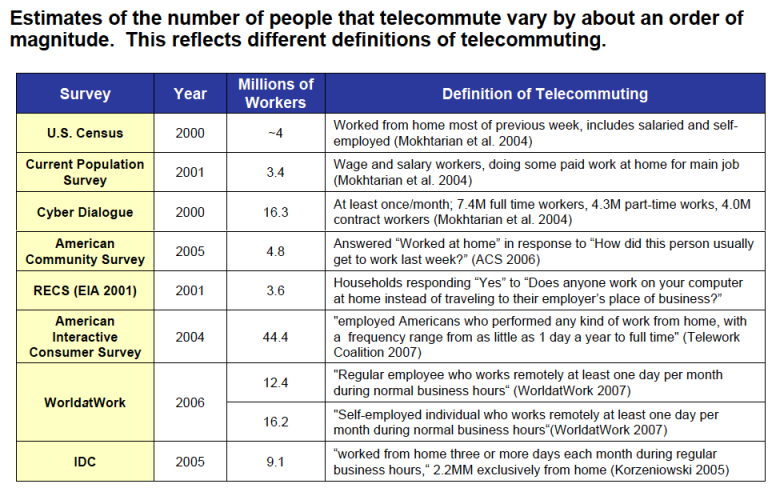
Source: Consumer Electronics Association, July 2007, Ref. No. D5525
Additional details from a wide range of studies are available on our Telecommuting Statistics and Pros & Cons of Telecommuting pages.